
Research & Teaching
Research
Pistis: Development of a Holistic Theory of Trust
My doctoral thesis, completed at QUT in 2025, develops a holistic theory of trust that builds from its most primordial, intuitive form. Drawing on quantum cognition, philosophy of mind, and evolutionary psychology, and reaching back to thinkers including Heidegger, Bohm, Parmenides, and Homer, the work traces trust from its ancient conceptual roots to its expression in contemporary human-AI and extreme environment contexts. The theory is termed Pistis, from the ancient Greek for trust, faith, and reliance.
Trust in Extreme Environments
Applying the Pistis framework to trust in off-Earth habitation contexts, including a simulated lunar mission at the HI-SEAS analog habitat in Hawai'i, where I served as Vice Commander. Presented at the International Astronautical Congress 2025, Sydney.
Contextuality and Trust in Human-AI Interaction
Ongoing work investigating how contextuality, as formalised in quantum cognition, shapes trust decisions in interactions with AI systems. Part of a broader collaboration within the QUT Quantum Interaction research group.
Social Predictions of Faces
Using experimental paradigms to test quantum models in the way people make predictions about others based on facial appearance.
Virtual Reality for People with Cognitive Impairments
Ongoing involvement in projects investigating immersive digital experiences to support people with intellectual disability in learning and navigation contexts.


Publications
Selected publications are listed below. For a full list with citation metrics, see the Publications page or Google Scholar profile.
Bruza, P. D., Fell, L., Hoyte, P., Dehdashti, S., Obeid, A., Gibson, A., & Moreira, C. (2023). Contextuality and context-sensitivity in probabilistic models of cognition. Cognitive Psychology, 140, 101529.
Fell, L. (2020). Trust and COVID-19: Implications for interpersonal, workplace, institutional, and information-based trust. Digital Government: Research and Practice, 2(1), 1-5.
Fell, L., Gibson, A., Bruza, P., & Hoyte, P. (2020). Human information interaction and the cognitive predicting theory of trust. Proceedings of the 2020 Conference on Human Information Interaction and Retrieval.
Sitbon, L., Brown, R., & Fell, L. (2019). Turning heads. 21st International ACM SIGACCESS Conference on Computers and Accessibility.
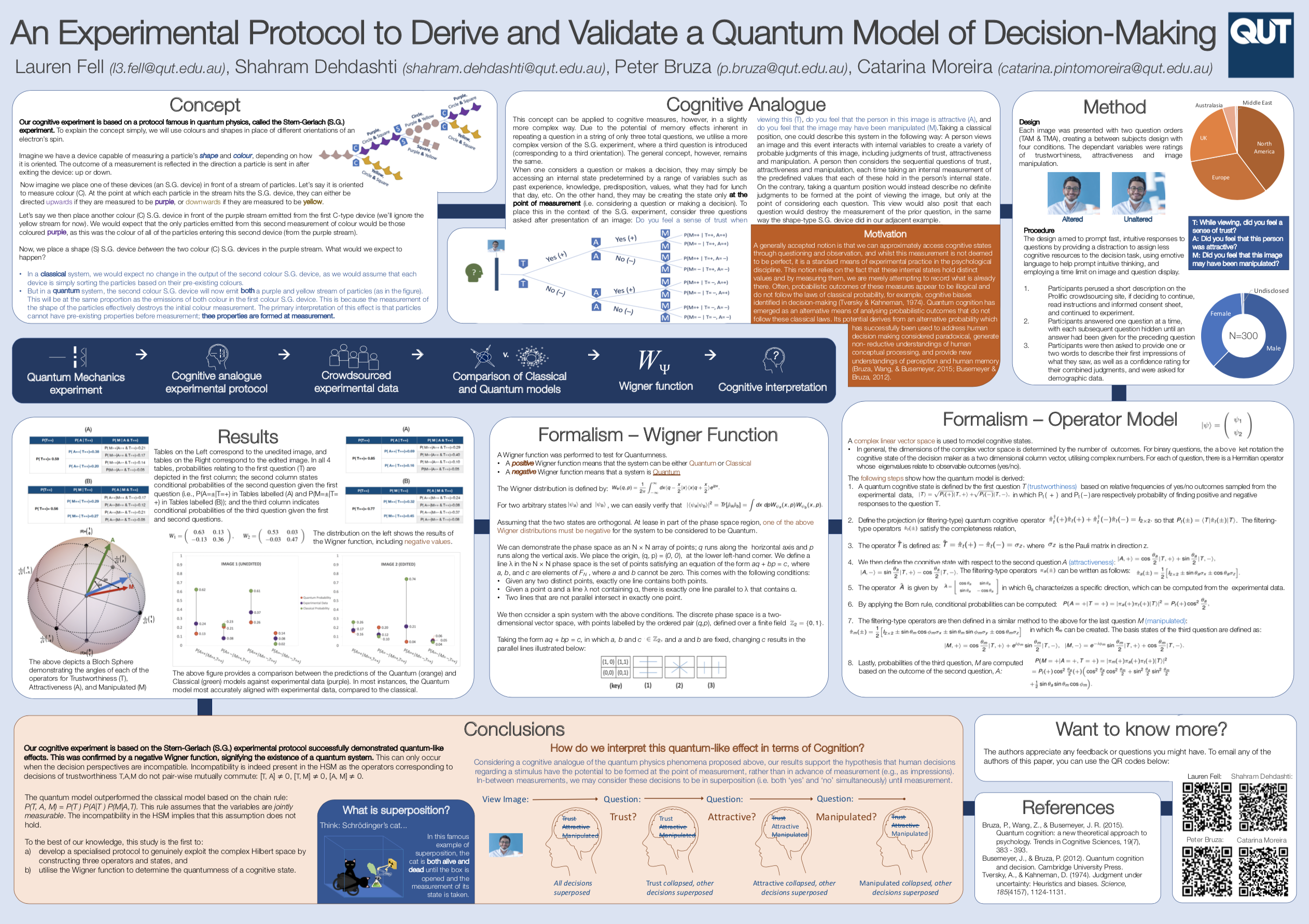
Fell, L., Dehdashti, S., Bruza, P., & Pinto Moreira, C. (2019). An experimental protocol to derive and validate a quantum model of decision-making. Proceedings of the 41st Annual Meeting of the Cognitive Science Society.

Teaching
I was Associate Lecturer in the Masters of IT at Queensland University of Technology for six years, and continue to contribute as a sessional lecturer and guest. I contributed to the creation and ongoing delivery of units drawing on my background in UX, psychology, and cognitive science.
IFN521 surveys basic principles of cognitive and social psychology relevant to understanding the individual as information processor. It provides perspectives and theories of how humans interact with information, and how these relate to information organisation, information requirements, and information governance.
IFN623 aims to provide an understanding of the cognitive architecture of human beings and how that influences human behaviour in information interactions. It also develops knowledge of the fundamentals of contemporary information management from both a conceptual and technological perspective, covering human information processing, human information interaction, and information processing technologies.